“If you’re running a productivity or an infra company in 2026, humans are no longer your users. Agents are.”
The DAU/MAU ratio told you how habitual the product was for humans, where 50% and up meant you had a killer product. But that worked when your product was used by humans.
Now their agents are doing the work.
Here’re some of my observations on how to build the product agents reach for, and how to measure when they do:
Before AI agents
Measuring DAU made sense in a world where you expected users to live inside your product.
If people spent more time in it, that usually meant the product was delivering value, or it had strong enough network effects to keep pulling them back in.
In fact, many productivity tools (Notion, Linear, Figma, Slack) or developer tools (GitHub, Vercel, Datadog) adopted seat-based pricing models designed around human access:
- how many people can enter the product,
- what permissions they have, and
- what features they can touch.
But, humans are slow to pick up new skills and learn new interfaces. To help them out, PMs and marketers obsessed over making the best onboarding experience and hyper-personalized drip campaigns.
They also made it really hard for people to churn from their products, because they already spent a significant time onboarding and learning their UI. The sunk cost fallacy is hard to fight once you’ve spent 100+ hours in a product… anyone who runs their CRM on HubSpot knows this well.
Now, luckily for us, AI is changing this narrative and many productivity tools are adapting to this new reality.
The agent-native internet
AI assistants like OpenClaw, Hermes and Vellum (disclaimer: I work here) can use any productivity/dev-tool software on your behalf. And, it looks like every company is taking notes.
The last 3 months every launch has been around agent-facing APIs, CLIs, MCPs, and connectors:
- Stripe built their payments CLI for agents via Link
- Notion just launched their External agents API
- Cloudflare built their own CLI and basically shifted their business model
- Linear has impressive Slack connectors and your AI assistant can write PRDs, close and open issues
- Google published their own official CLI where agents can use their products
- Figma opened the canvas to agents with their use_figma MCP.
- Vercel has a really good agent-native CLI that let’s you host websites almost instantly
AI agents can file receipts, organize your inbox, create pixel perfect code from designs, monitor your finances, pull analytics from Stripe and align your team in Slack. Yes, the tech is that good and reliable .. and this is the worst that it’ll ever be.
As agents continue to get better, humans will be required for less and less work.
So, your product will need to become agent-native too.
How to build an agent-native product
To build an MVP with these agentic preferences you need to do few things well.
i. Programmatic parity: Every workflow a human can do in the UI has to be doable via API. Stripe for example has the high bar here, with near-complete coverage of dashboard actions in the API.
ii. Support for multiple agent surfaces
REST API. The minimum for an agent to work well; any agent that can make an HTTP request can use your product. Great for coding agents: SDKs in Node, Python, and Go. Language-specific wrappers around the API that save the agent from writing boilerplate for auth, retries, and types. Great for AI assistants: CLI & MCP support. Lets Claude, Cursor, OpenClaw, Vellum and other LLM assistants pick up your product. The benefit of this is that it allows the LLM to pick up your product directly as a tool call instead of it needing to write code first
iii. Docs an agent can actually read: This is the new onboarding you should care about. Agents will read your docs in 50ms and decide if they can do the task. This is where your AIO/GEO strategy becomes a mid-of-funnel technique. That means:
- a working example next to every endpoint,
- real request/response payloads instead of placeholders,
- a single endpoint reference instead of a marketing-doc maze,
- a stated versioning policy, and
- an
/llms.txt(or equivalent) that gives an agent the map of your docs in one file.
iv. Agent identity + safety primitives: Agents need their own token, their own rate limits, their own audit trail. Plus the must-have safety pieces:
- idempotency keys (retries don’t double-charge),
- dry-run or preview environments and endpoints (agents can test),
- webhook signing (agents can trust events)
v. Distribution into agent ecosystems: Be where the agents already are: MCP marketplace listing, native integration into Claude Desktop, ChatGPT, Cursor and visible in agent registries (e.g. skills.sh by Vercel).
All of the above makes it very easy for agents to come back to your product and get the work done, reliably. Sadly, all of this enablement is only a temporary moat.
When the user is an agent that reads docs in 50ms and migrates faster than a human clicking a button, there isn’t a lot left to defend.
As a result, tracking agent usage & outcomes will become the new task for marketers, and figuring out how to keep agents coming back is going to take avenues that are still mostly unknown for most of us.
Tracking agent usage & outcomes
It’s not hard to assume that the new generation of lifecycle marketers will focus on measuring new types of metrics: how many agents are doing real work in your product, how often, and how valuable is the work they’re doing.
So now, we start to care about things like:
- Daily Active Agents instead of DAU: how many distinct agents acted in your product today
- Actions completed: the new “MAU minute”. A single agent doing 50 useful actions matters more than 50 humans clicking around
- Outcomes: tickets resolved, leads enriched, deploys shipped, deals updated, files generated
- Repeat agent visits: do agents come back to do more work, or was it one-off
- Time-to-first-useful-action: how fast can an agent do real work in your product, end to end (this is the agent’s “aha moment”)
- Agent-to-human ratio: for every 1 human user, how much work do agents do downstream
In fact, the whole lifecycle marketing playbook (drip campaigns, push notifications, “we miss you” emails, onboarding sequences) was built for humans who get nostalgic, feel guilty about lapsed subscriptions, and open re-engagement emails on a Sunday night.
Agents don’t do any of that, so the entire marketing function around DAU has to be reinvented for DAA, and it’ll be a fun journey to define it.
How our work has changed
Our engineering and GTM team @ Vellum barely open some productivity tools anymore. And over the last 3 months, we’ve been churning from many of them. The most recent was Webflow, and we saved $30K/year.
Today, our assistants:
- Log tickets in Linear automatically via Slack
- Write PRDs in Notion and ask for feedback in Slack
- Write content and leave comments in Notion docs
- Design transactional emails and puts them in Resend
- Pass our content into Sanity (headless CMS)
- Manage our Gmail and designs slides in Google Slides
- Use the GitHub CLI to push, review and merge code
- Write, schedule and manage our social content calendar on Typefully
- Look into our Hubspot data so we never have to look at it again
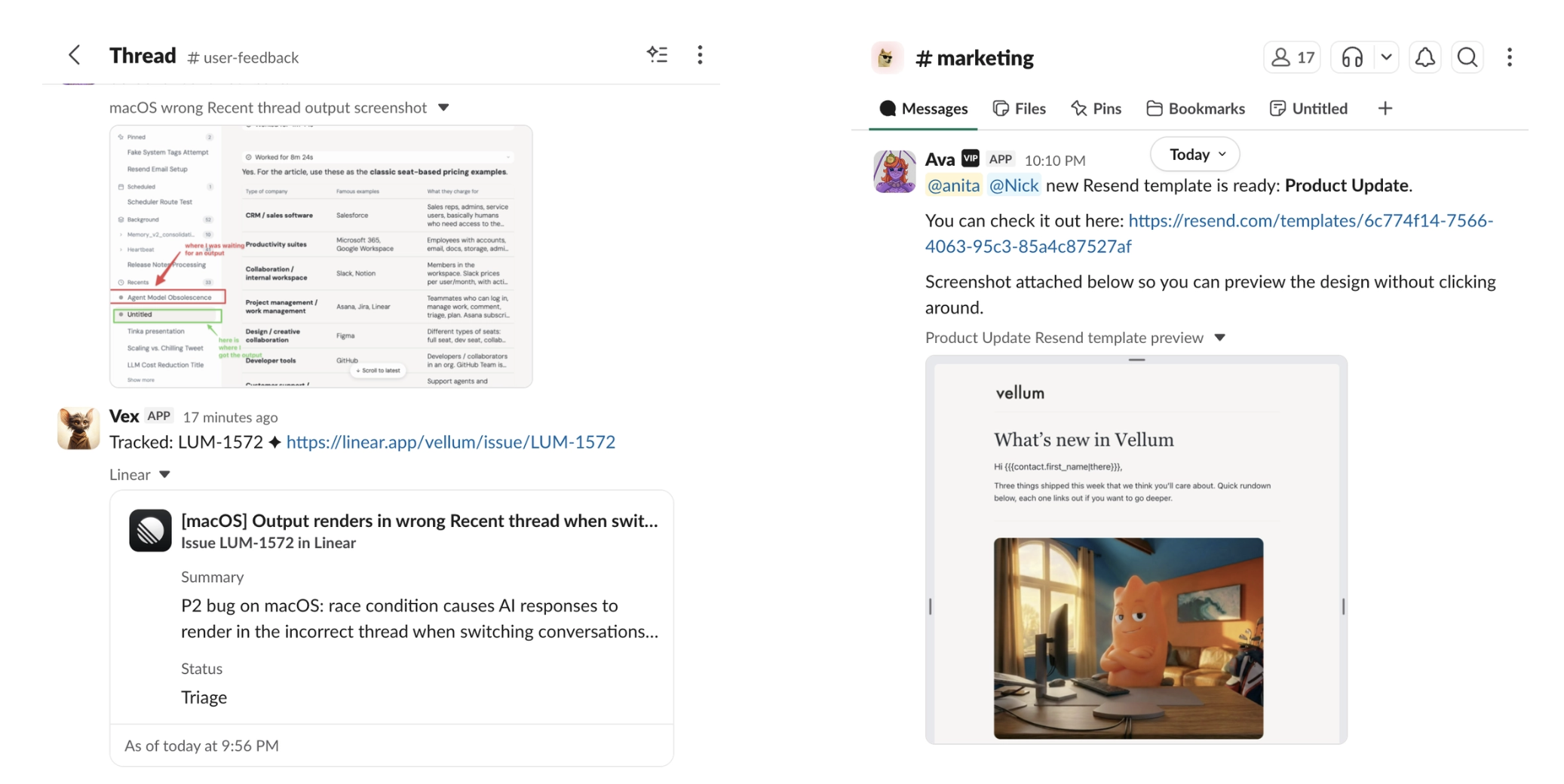 Left: Vex (Ashlee’s assistant) tracking a Linear bug. Right: Ava designing an email in Resend.
And this is just the start.
Thank you for reading
If this resonated, follow me here on X. I post about what’s actually happening in AI, how I’m using it in my own work, and how we’re building Vellum, the AI assistant for your everyday work.
Thanks to @dvargasfuertes, @grim_tonal and @asharma_53 for the contributions in this post.